Call020 4520 0354 Emailinfo@kingstonminibushire.co.uk Quote within the hour
Kingston Minibus Hire KT1 · KT2 · Royal Borough of Kingston upon Thames

Minibus & coach hire with a driver

Minibus hire in Kingston, where the middle of the town is closed to you

Eight to seventy seats with a driver across KT1 and KT2. Hampton Court, Chessington, weddings, airport runs and nights out — quoted within the hour by a person.

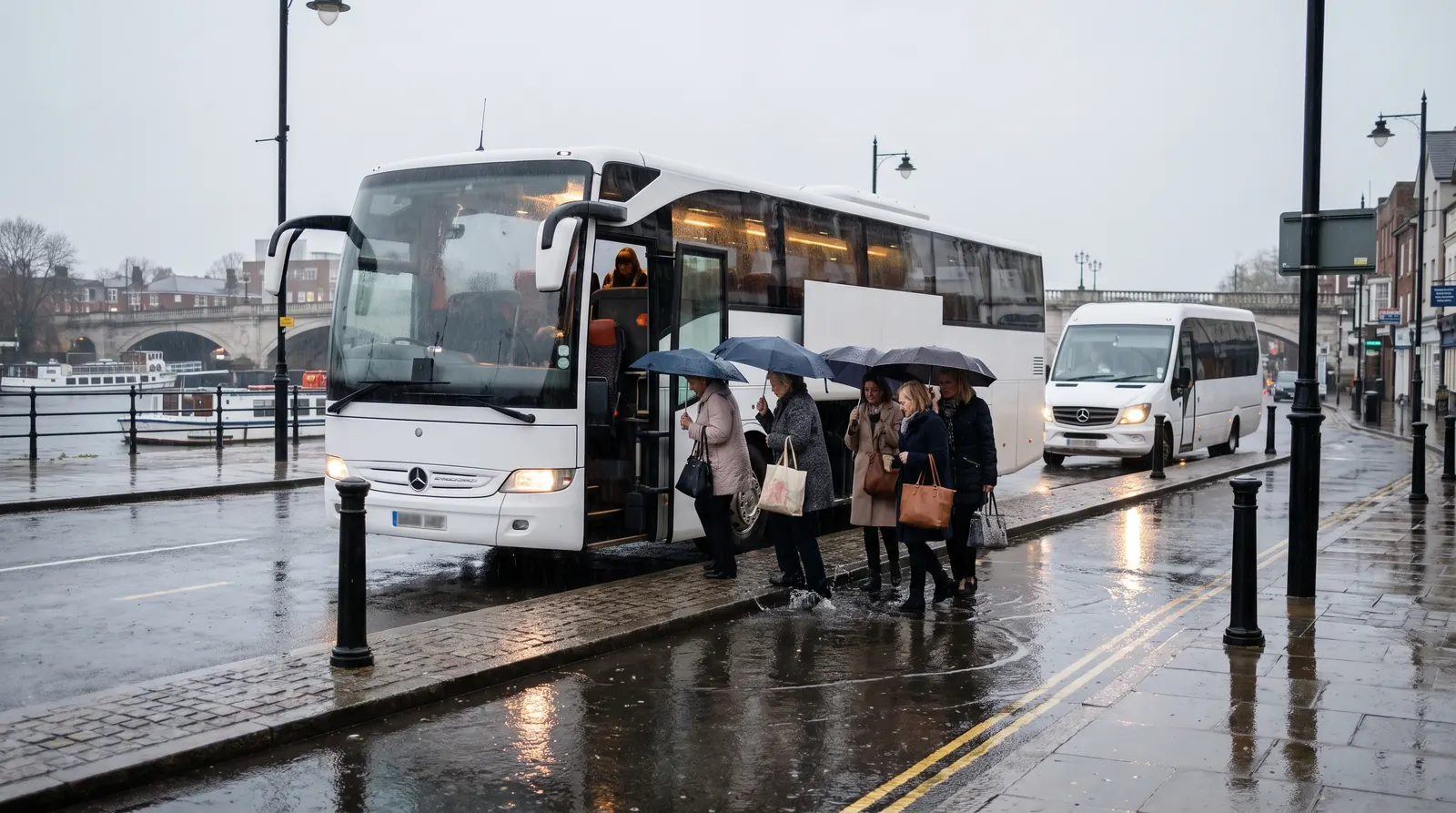
A white touring coach with a minibus parked behind it at the kerb on the riverside road beside the Thames at Kingston in steady rain, a group of women in party clothes boarding through the open door under umbrellas, the bridge and moored boats behind
The riverside road by the bridge, in the rain. Two vehicles on one job is normal in Kingston — the coach waits where it can legally stand, the minibus goes in for the people who cannot walk that far.
  • The town centre is not a place you can drive a coach. Kingston’s core is pedestrianised and wrapped in a one-way ring. We plan the set-down point before we quote, not on the day.
  • A 16-seater goes where a coach cannot. Twenty-nine signed height limits sit within a few miles of KT1, and the ones that matter most are in Kingston itself.
  • LEZ and ULEZ compliant. Kingston is inside Greater London, so both zones apply. Nothing is passed on to you.
  • DBS-checked drivers for school and youth groups, seatbelts throughout, risk assessments on request.
Talk to a person 020 4520 0354

Get a price

Two short steps. No obligation, no automated number.

1. The journey2. How to reach you
Your journey
One way or return?
What people hire us for

Six reasons a group in KT1 books a minibus rather than a coach

01

The centre is shut to traffic

Kingston’s core streets are pedestrianised or bus-only. A vehicle cannot wait outside the restaurant, the theatre or the shop. The job is always a set-down somewhere legal and a pick-up somewhere legal, and the smaller the vehicle, the more of those places exist.

02

Hampton Court is over the bridge

The biggest group day out within reach is a short run west across Kingston Bridge — and it is in a different borough with its own coach rules, which we quote further down in the palace’s own words rather than ours.

03

Weddings along the river

Canbury Gardens, the riverside walk and the lanes off the Market Place are narrow and pretty and full of bollards. Wedding work here is shuttle work — three or four short runs — and a 16-seater turns where a 53-seater has to reverse.

04

Airport runs

Heathrow is the near one, out on the A308 and A30 or round the M25. Gatwick down the M23, Luton and Stansted round the top. Luggage in the hold rather than on four people’s laps.

05

School, university and club trips

DBS-checked drivers, seatbelts throughout, risk assessments on request. Kingston has a university across several campuses and a dense band of schools, and a 24 or 33-seat midi usually beats two minibuses on cost.

06

Nights out and late returns

Kingston is one of south-west London’s busiest nights out, and the last train from Waterloo is not a plan. One pick-up point, one driver, one bill, everyone home together.

Things to do

What’s actually in Kingston

Fact file

Postcodes covered
KT1 · KT2
Council
Royal Borough of Kingston upon Thames
LEZ / ULEZ
Inside both — Kingston is Greater London
Signed height limits nearby
29 within about 6 km — but only 9 in this borough
Roads here that stop a coach
One. Queen Elizabeth Road, Norbiton, 10′3″
Our depot
Fairfield Trade Park, Villiers Road, KT1 3AY

Kingston is a market town that London grew around without ever quite absorbing. It has a medieval bridge crossing, a Saxon coronation stone, a market square still trading, and a shopping centre that pulls in more people than most county towns hold. What it does not have is anywhere obvious to put a coach — and that is the single most useful thing to know before you book one.

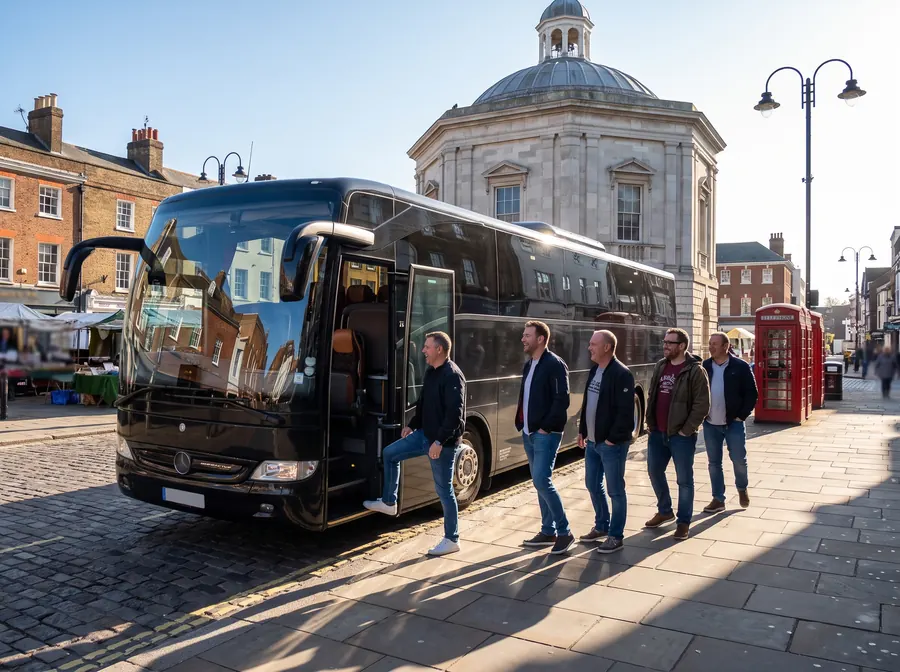
A sleek black executive coach parked at the kerb beside the old market square in Kingston upon Thames on a bright summer morning, a group of men in casual clothes boarding through the open door, the domed market house behind them
The Market Place on a clear morning. The square itself is closed to traffic for most of the day, so anything with wheels waits on the ring and the party walks the last two minutes.

The Market Place and the Coronation Stone

The market square is the oldest working part of the town, and the block of stone outside the Guildhall a short walk away carries the claim Kingston is best known for: that Anglo-Saxon kings were crowned here. The full story is at the bottom of this page, and it is more interesting than the plaque.

Section to be completed from verified sources.

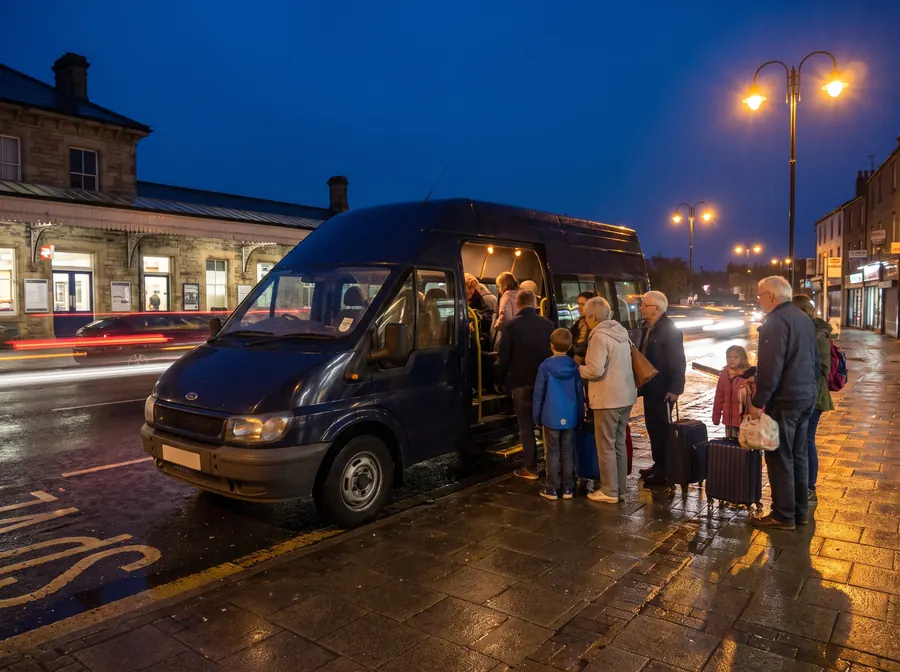
A dark navy 16-seat minibus at the kerb on the road outside Kingston railway station at night, an extended family of mixed ages boarding with suitcases, wet tarmac reflecting orange streetlights and car light trails behind
The road outside the station at night. Trains and a minibus meet here more often than anywhere else in Kingston — and the station is one of the few places in the centre a vehicle can legitimately wait for a moment.
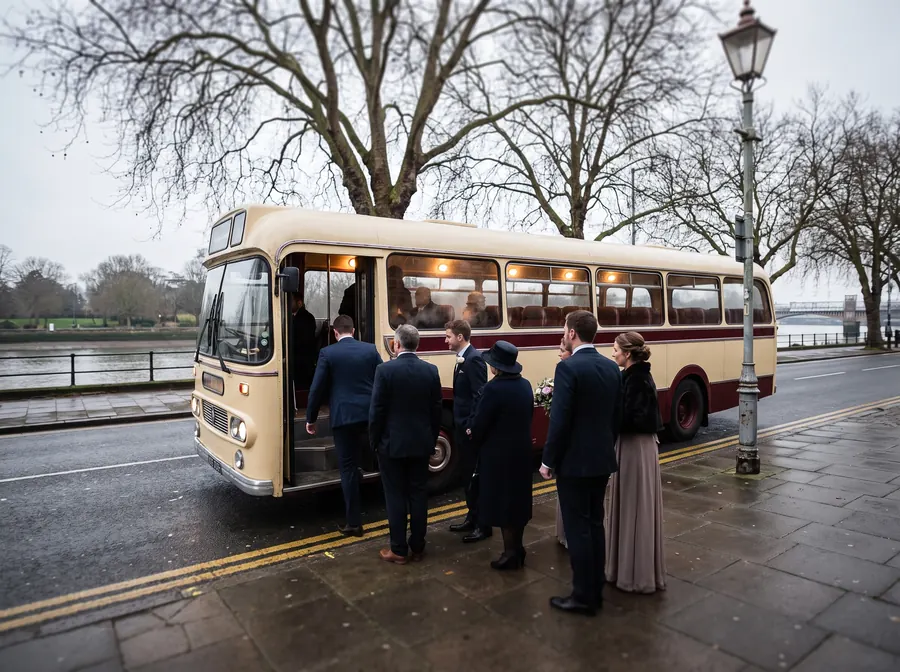
A cream and burgundy touring coach parked on the road beside Canbury Gardens on the Thames at Kingston on an overcast winter afternoon, a wedding party in hats and formal dress boarding, bare mature trees and the river behind
The road by Canbury Gardens on a winter afternoon. North of the centre the riverside opens out and a full-size coach becomes possible again — which is why so much Kingston wedding work starts here rather than in the town.

Almost every Kingston job comes down to the same question, and it is not what you would expect. It is not “how many seats?”. It is “where exactly are you standing when we arrive?” Something we ask on most KT1 bookings

The practical bit

Where a minibus can actually pick up in Kingston

Most town pages guess at this. Kingston does not make you guess: the Royal Borough publishes a coach parking page with every coach stop and coach stand in the borough, what it serves, what it costs and how long you may stay. It is the most useful page the council has, and hardly anybody reads it.

Its own two definitions are worth having in front of you, because they are the difference between setting people down and leaving a vehicle:

Coach stops are “free and allow buses or coaches to set down or pick up passengers (some have a maximum stay)”. Coach stands are “for long stay, pay and display during controlled hours”.kingston.gov.uk · checked 29 August 2026

The five coach bays in Kingston town centre

Coach stops and coach stands published by the Royal Borough of Kingston upon Thames for Kingston town centre, with what each serves, the cost and the maximum stay
Where Type Bays What it is for Cost Maximum stay
High StreetCoach stop1The Rose Theatre, oppositeFree30 minutes, no return within 1 hour
ThamesideCoach stop1Turks PierFree30 minutes, no return within 2 hours
Fairfield RoadCoach stop1Library, museum, Kingfisher PoolFree1 hour, no return within 2 hours
Old London RoadCoach stop1The TravelodgeFree1 hour, no return within 2 hours
Birkenhead Avenue, KT2Coach stand2General use — the one you can actually leave a vehicle in£1.40/hour, Mon–Sat 8.30am–10.30pm and Sun 11am–10.30pm10 hours, no return within 2 hours

Elsewhere in the borough the council also lists Lamberts Road in Surbiton (one bay for Hollyfield School, free, weekdays 8.30am–6.30pm, 20 minutes) and Cocks Crescent in New Malden (five bays, free, Mon–Sat 8am–10pm, no maximum stay and overnight parking permitted — by some distance the most generous coach facility in the Royal Borough). All read from kingston.gov.uk on 29 August 2026; the page carries no last-updated date, so confirm before the day.

Read the last column, because it decides the whole job

Four of the five town-centre bays are free, and four of the five give you thirty minutes or an hour and then a no-return rule of one to two hours. That is a set-down, not a wait. Nobody is parking a coach on the High Street while a group has lunch.

Which is why the honest shape of a Kingston job is nearly always the same: set down at a named bay, the vehicle leaves, the vehicle comes back. If the group genuinely needs the vehicle to stay, it goes to the Birkenhead Avenue stand and someone pays for it. We would rather quote you that properly than pretend the problem is not there.

And the middle of the town is closed to you anyway

Kingston’s core is a pedestrian precinct. Clarence Street, the Market Place, Church Street, Castle Street, Union Street, Thames Street and part of Wood Street are pedestrianised or pedestrian-priority, with a bus-and-taxi-only section on Clarence Street and a camera-enforced bus gate on Eden Street — a street with a reputation for penalty notices. The Ancient Market Place went further in November 2024, when the council replaced the old timed access via Union Street with a restriction that runs twenty-four hours, deliveries entering from the High Street between 5 and 10 in the morning and 4 and 6 in the afternoon.

We will be straight about one thing: the council does not publish a single table of hours for the pedestrian zone, and we could not find one anywhere official. Anybody quoting you exact minutes for when Clarence Street opens and shuts is telling you something they cannot show you. What is publishable, and enforced, is that these streets are not a route or a waiting place for a hired vehicle.

Around the pedestrian core: the one-way ring, and a parking zone that runs to half past ten

What loops around the precinct is the one-way system — Clarence Street, Cromwell Road, Wood Street, Wheatfield Way, Kingsgate Road, Horse Fair and Penrhyn Road, almost all of it one-way, multi-lane, 20 mph and now threaded with the cycle tracks built under Kingston’s Go Cycle programme. A driver who misses a turn on it does not simply turn round; they go round again. That is the single biggest reason we want the set-down point agreed before the day rather than found on it.

The controlled parking zone matters just as much, because its hours are longer than most people expect:

  • Zone A, the outer town centre — Monday to Saturday, 8.30am to 6.30pm, including bank holidays.
  • Zone A1, central Kingston — Monday to Saturday, 8.30am to 10.30pm, and Sunday, 11am to 10.30pm. Thames Street and Bishops Hall carry an extra Sunday, 12pm to 5pm restriction.

Zone A and A1 between them cover 61 named streets, the High Street, Thames Side, London Road and Kingston Bridge among them. Read from kingston.gov.uk, 29 August 2026.

The car parks will not take the vehicle, with one exception worth knowing

The council publishes the heights, and they are brutal. Cattle Market surface car park on Fairfield North, KT1 2QY, is signed at 7 ft (2.15 m) — under a 16-seat minibus, never mind a coach. Ashdown car park, KT1 2NH, is worse at the front: 6 ft (1.8 m) on the Ashdown Road entrance. But the council adds one sentence that is worth the whole page — there is no height restriction on the Lady Booth Road entrance. If a vehicle has to go into a Kingston car park, that is the way in.

The Bentall Centre publishes its car park hours and tariffs but no height limit that we could find, so we will not quote you one. Assume a shopping-centre deck is a car park until somebody at the centre tells you otherwise in writing.

Where we set down in practice

  • Kingston station, Wood Street, KT1 1UJ — the default for anything meeting a train. Note that South Western Railway states plainly that car parking is not available at this station; the taxi rank is off Wood Street by the south entrance, and Wood Street is one-way and inside the parking zone. It is a stop, not a wait.
  • The High Street coach stop for the Rose Theatre — thirty minutes, which is exactly enough to unload a theatre party and go.
  • The Thameside coach stop for anything on the water at Turks Pier, and for the riverside walk north.
  • Fairfield Road for the museum, the library and Kingfisher Pool — a full hour, the most relaxed of the free bays, and a short walk from the Market Place.
  • Birkenhead Avenue when the vehicle genuinely has to stay, and we will price the stand into the quote rather than let a driver find out on the day.
  • Canbury Gardens and the riverside north of the bridge for weddings and river work, where the road opens out and a full-size coach stops being a problem.
  • Cromwell Road, beside the bus station, for large groups going out of town — it is built for buses, which is the whole point.

Tell us the venue and the time, and we will name the bay and the vehicle in the quote. Parking rules, bay locations and maximum stays are set by the Royal Borough and change — we check them for your date, but a driver always obeys the sign in front of them over any list, including this one.

The bit nobody publishes

Twenty-nine height limits near Kingston. Nine are in Kingston. One of those stops a coach.

A coach is shorter than the internet thinks. A Mercedes-Benz Tourismo — the commonest 49 to 53-seater on British roads — is 3.68 m with the air conditioning on its roof, and a 53-seat MAN Lion’s Coach is 3.87 m. We plan to 3.9 m, because at the point of booking we do not know which comes out of the yard. A 16-seat minibus needs about 2.8 m. The famous 4.4 m is a double-decker. Three numbers, three different maps of the same signs.

There is a second problem with lists like this and it is worse than the first. Height data collected on a radius around a town centre picks up everything within a few miles, and from Kingston that means St Margarets, Petersham, Strawberry Hill, Hampton, Long Ditton, Thames Ditton and Esher. We checked all twenty-nine coordinates against OpenStreetMap’s own reverse geocoder one at a time. Twenty of them are not in this borough. Nine are in Richmond upon Thames, one is in Merton, and ten are outside Greater London altogether, in Elmbridge in Surrey.

Table one: the nine inside the Royal Borough of Kingston upon Thames

Signed height limits inside the Royal Borough of Kingston upon Thames, with what kind of way each one is on, and whether a 2.8 m minibus, a 3.9 m full-size coach and a 4.4 m double-decker clear it
Road Where What it is Signed limit Minibus 2.8 m Coach 3.9 m Decker 4.4 m
Queen Mary CloseTolworth, KT6 4.3 kmService road2.00 mNoNoNo
Thames SideKingston town centre, KT1 0.4 kmService road2.50 mNoNoNo
Elm RoadNew Malden, KT3 3.0 kmResidential through road9′0″ · 2.74 mNoNoNo
Queen Elizabeth RoadNorbiton, KT2 0.8 kmPublic road, covered section10′3″ · 3.12 mYesNoNo
Skerne RoadKingston, KT2 0.4 kmCovered cycleway, not a road3.80 mn/an/an/a
Brighton RoadSeething Wells, Surbiton, KT6 2.1 kmA-road4.50 mYesYes10 cm
Cox LaneChessington, KT9 4.6 kmThrough road4.60 mYesYesYes
Moor LaneChessington, KT9 5.0 kmThrough road4.60 mYesYesYes
Kingston RoadTolworth, KT5 4.1 kmTrunk road, the A3 corridor4.60 mYesYesYes

Read that table from the third column, not the fourth

Three of the nine are not roads in any sense that matters to you. Skerne Road’s 3.80 m sign is on a covered cycleway, not on the carriageway — it is in the data because a height tag is a height tag, and it would be dishonest to bill it as a coach restriction on a Kingston street. Thames Side and Queen Mary Close are service roads: real signs, real limits, but access ways rather than through routes.

Set those three aside and the borough gets very simple. Elm Road in New Malden, signed 9′0″, is a residential through road that stops everything, a 16-seat minibus included. Queen Elizabeth Road in Norbiton, signed 10′3″, is the only public through road in the whole Royal Borough that stops a full-size coach and lets a minibus past. And that is the list. Everything else in Kingston clears a 53-seater with room to spare.

Which is worth saying plainly, because it is the opposite of what a coach operator’s page usually implies: height is not what limits a coach in Kingston. The town centre’s traffic rules are.

Table two: the twenty that are near Kingston but not in it

These are still worth having, because Kingston groups cross into all three of these areas constantly — over the bridge to Hampton Court, up the river to Twickenham, out to Esher and Claygate. They are simply not Kingston’s, and no page should tell you they are. Distances are straight-line from the middle of Kingston.

Signed height limits within about six kilometres of Kingston town centre that are in a different borough or district, with the place they are actually in
Road Actually in Limit Minibus 2.8 m Coach 3.9 m Decker 4.4 m
Arragon Road multi-storeySt Margarets, LB Richmond 4.6 km1.93 mNoNoNo
Paradise Road car parkPetersham, LB Richmond 5.6 km1.96 mNoNoNo
Lower Downs RoadRaynes Park, LB Merton 6.0 km2.36 mNoNoNo
River Crane Walk (tunnel)Strawberry Hill, LB Richmond 5.0 km2.44 mNoNoNo
Angel RoadLong Ditton, Elmbridge, Surrey 3.3 km2.70 mNoNoNo
More Lane (tunnel)Esher, Elmbridge, Surrey 5.5 km3.05 mYesNoNo
Lower Green RoadEsher, Elmbridge, Surrey 4.7 km3.30 mYesNoNo
Ewell RoadLong Ditton, Elmbridge, Surrey 2.9 km3.35 mYesNoNo
Priory RoadHampton, LB Richmond 5.4 km3.50 mYesNoNo
RiversideSt Margarets, LB Richmond 4.3 km3.70 mYesDependsNo
Mary’s TerraceSt Margarets, LB Richmond 4.8 km3.73 mYesDependsNo
Popes GroveStrawberry Hill, LB Richmond 4.2 km3.80 mYesDependsNo
Station Road (tunnel)Esher, Elmbridge, Surrey 4.7 km3.96 mYesYesNo
Portsmouth RoadWeston Green, Elmbridge, Surrey 4.2 km4.00 mYesYesNo
Windmill LaneLong Ditton, Elmbridge, Surrey 2.7 km4.00 mYesYesNo
Colne RoadStrawberry Hill, LB Richmond 4.6 km4.11 mYesYesNo
Claygate LaneHinchley Wood, Elmbridge, Surrey 3.6 km4.20 mYesYesNo
Saint Mary’s RoadLong Ditton, Elmbridge, Surrey 2.6 km4.27 mYesYesNo
Hare LaneClaygate, Elmbridge, Surrey 5.9 km4.34 mYesYesNo
Lower Teddington RoadHampton Wick, LB Richmond 0.5 km4.34 mYesYesNo

Two entries in table two that other people’s pages get wrong

Lower Teddington Road has a KT1 postcode and sits half a kilometre from Kingston Market Place. It is not in Kingston. It is in Hampton Wick, over the bridge, in the London Borough of Richmond upon Thames — and at 4.34 m it does not stop a coach anyway. It stops a double-decker.

And the two car parks are not Kingston’s car parks. Arragon Road multi-storey is in St Margarets and Paradise Road is in Petersham, four and a half and five and a half kilometres away, in Richmond’s borough. A page that lists a 1.93 m barrier under the heading “parking in Kingston” is describing somewhere you were never going.

Road heights from OpenStreetMap contributors, ODbL, checked road by road against the OpenStreetMap reverse geocoder and the live Overpass API on 29 August 2026 — which is where the “what it is” column comes from, and how the Skerne Road cycleway was caught. Where the sign is recorded in feet and inches we show it that way, because that is what is on the post. Vehicle heights are manufacturers’ own figures — Mercedes-Benz Tourismo 3.68 m including roof air conditioning (mercedes-benz-bus.com), MAN Lion’s Coach 53-seat 3.87 m (lectura-specs.com) — and the three verdict columns are our own arithmetic against them, not a signed instruction. A 10 cm margin is not a margin, which is why Brighton Road is marked the way it is. Signed limits change: a driver trusts the sign over any list, including this one.

Before you compare quotes

Kingston is inside the London LEZ and the ULEZ

Both zones cover the whole of Greater London, and the Royal Borough of Kingston upon Thames is inside it. Which one applies depends on the vehicle:

  • Coaches and minibuses over 5 tonnes fall under the Low Emission Zone. A non-compliant vehicle pays £100 a day unless it meets Euro VI.
  • Minibuses at or under 5 tonnes fall under the Ultra Low Emission Zone, at £12.50 a day if non-compliant.

Our vehicles are compliant, so there is nothing to pass on. It is worth asking any operator quoting you from just outside the boundary — Esher, Thames Ditton, Claygate, Walton and Weybridge are all a short run away and all outside Greater London — whether a daily charge is buried in the price rather than shown as a line.

Charges and boundaries are set by Transport for London and change. We confirm the position for your vehicle when we quote.

The local day out

What the places near Kingston publish about groups

Their words, with the date we checked.

To be completed

Verified venue quotes pending

Further afield

Where Kingston groups go by coach

Four where the venue publishes its own arrangements for a coach party. Their words, with the date we checked — and note that two of the four are warnings rather than welcomes.

Arundel Castle & Gardens

approx. 90 km · West Sussex

“For Coach Drivers bringing groups (20 minimum) we offer complimentary coach parking”arundelcastle.org · checked 29 Aug 2026

Group rates need twenty adults for the free-flow castle and gardens ticket, fifteen for the guided garden tour. Twenty is a 24-seat midi with room to spare.

Blenheim Palace

approx. 115 km · Oxfordshire

“Free coach parking is available in the grounds with the exception of certain event days, when parking may be charged”blenheimpalace.com · checked 29 Aug 2026

Discounts start at fifteen paying visitors, and groups of fifteen or more book through their group sales team rather than the ordinary online portal. Read the event-day exception before you assume the parking is free on your date.

Chatsworth House

approx. 290 km · Derbyshire

“Please note that we cannot accept any unbooked coaches/mini-buses and their passengers.”chatsworth.org · checked 29 Aug 2026

Their own definition: a group is fifteen or more paying visitors arriving by coach with a pre-booked timed slot. Turning up is not an option, for a minibus either.

Cardiff Castle

approx. 250 km · Cardiff

“It is no longer possible for coaches to drop off directly outside the Castle.”cardiffcastle.com · checked 29 Aug 2026

Drop-off has moved to a layby on North Road, with coach parking at Sophia Gardens or the Civic Centre. Group benefits are published for pre-booked parties of between fifteen and thirty.

Also popular from Kingston

Bluebell Railwayapprox. 70 km · East Sussex
Leeds Castleapprox. 90 km · Kent
Royal Pavilion, Brightonapprox. 90 km · East Sussex
Bletchley Parkapprox. 100 km · Buckinghamshire
Portsmouth Historic Dockyardapprox. 105 km · Hampshire
Beaulieu & the National Motor Museumapprox. 130 km · Hampshire
The Roman Baths, Bathapprox. 180 km · Somerset
Cadbury World, Bournvilleapprox. 210 km · West Midlands

Distances are approximate road estimates from KT1, not measured routes. All eight were confirmed open on 29 August 2026, but one carries a warning worth passing on: the Roman Baths publish that there is no parking at the Baths themselves, only car parks within walking distance. We ring ahead on any venue that stays quiet about vehicles, and we would tell you if the answer was no.

The fleet

Sizes we run from Kingston, and how tall they stand

Minibuses first, because in this town they are usually the right answer.

8
Minibus
≈2.6 m
16
Minibus
≈2.8 m
19
Minibus
≈2.9 m
24
Midi coach
≈3.3 m
33
Midi coach
≈3.5 m
49
Full coach
≈3.7 m
53
Full coach
≈3.9 m
70
Double-decker
≈4.4 m

Every job comes with a professional driver. Executive seating, wheelchair-accessible vehicles and school-spec vehicles are all available. For thirty people going somewhere with a tight approach, two 16-seaters will often beat one 33-seat midi — not because it is cheaper, but because both of them can actually get there.

The Coronation Stone, High Street, KT1 · 838–1850

The plaque says seven kings. The Chronicle names two.

Kingston’s most famous object is a lump of sandstone on a seven-sided plinth outside the Guildhall. The coronations are real. The number is traditional. The stone’s part in any of it is a guess that a Victorian committee cast in granite.

Historic England lists it as an “ancient sarsen stone, traditionally associated with a legend that seven Saxon kings were crowned upon it in Kingston in the C10”. Read that sentence slowly. Every load-bearing word in it — traditionally, legend — is doing work, and the list entry was rewritten in May 2023 to make sure it did. It is a public body politely dismantling its own town’s best story, and it is the most interesting thing in Kingston.

What the Anglo-Saxon Chronicle actually says

The Chronicle names Kingston for exactly two kings. Under the year 925, on the death of Edward the Elder: “And Athelstan was chosen king in Mercia, and consecrated at Kingston.” And under 979: “In this year was Ethelred consecrated king, on the Sunday fortnight after Easter, at Kingston. And there were at his consecration two archbishops, and ten diocesan bishops.”

That is the whole of it. The annals for 946, 955 and 975 record those accessions and say nothing about Kingston at all. The other names on the plinth come from elsewhere, and the elsewhere matters: Eadred from a charter recording gifts given “in the king’s residence which is called Kingston, where also the consecration was performed”; Eadwig from a life of St Dunstan written some forty years after the event, and famous only for the scandal at the coronation feast; and Edward the Elder, Edmund and Edward the Martyr from chroniclers writing generations later still.

The seven kings named on the Coronation Stone plinth, and what the surviving evidence for each one is
On the plinthWhere the claim comes fromHow solid
ÆthelstanAnglo-Saxon Chronicle, 925 — “consecrated at Kingston”Certain
ÆthelredAnglo-Saxon Chronicle, 979 — two archbishops, ten bishopsCertain
EadredA charter of 946 naming Kingston as the placeProbable
EadwigA saint’s life written c.40 years laterTraditional
Edward the ElderLater chroniclers onlyTraditional
Edmund ILater chroniclers onlyTraditional
Edward the MartyrLater chroniclers onlyTraditional
Not on the plinth: EdgarHistoric England: “Modern historians also think that Edgar was crowned in Kingston in 959”Missing

So the monument carries seven names, of which Historic England will vouch for two certainly and a third probably — and leaves off an eighth king the evidence rather supports. Professional archaeologists are more generous: Wessex Archaeology’s report on the Charter Quay excavations puts four as certain and three as possible. Nobody serious gets to seven, and nobody serious gets the same seven.

And the stone?

Here the ground gives way entirely. John Leland, William Camden and John Aubrey all wrote about Kingston. None of them mentions a coronation stone. The first time anything in print calls this particular block the stone the Saxon kings were crowned on is 1793, in the sixth edition of a London guidebook. Historic England dates the whole tradition to “probably … the late C18” and notes flatly that the identification is “disputed by modern historians”, with a rival theory that the stone was simply building material out of the collapsed chapel of St Mary. The London Geodiversity Partnership puts it in one line: “The traditional belief that the block was used as a ‘throne’ is not proven.”

What happened to it in between is not dignified. From 1825 it stood outside the old Guildhall in the Market Place, where, in Historic England’s words, “it was used as a public mounting block”. Around 1838 it was moved to the Assize Courts “to be used as a mounting block by county magistrates”. Thirteen years as a step for getting on a horse.

Then in 1849 an antiquarian from Leamington Spa named Henry Haughton Young noticed it, a committee formed, a design by a Mr C E Davis of Bath was chosen, and in 1850 the stone was set on a seven-sided granite plinth ringed by seven piers — the seven being an allusion to the seven kings, the names and dates cut into the stone in lead, with a coin from each reign set beneath. The indentations are still there. The coins, Historic England says carefully, are “now obscured”. Nobody has confirmed they are still in them.

On 19 September 1850 the town declared a public holiday. Thousands came to watch the Mayor, the Corporation and the Freemasons of Surrey process through Kingston, and the Provincial Grand Master anointed the stone with corn, oil and wine. The seven kings were, in the most literal sense, made up that afternoon.

The part that is unarguably true

None of which makes Kingston’s royal claim false. It makes it older than the stone. In 838 a great council met here, and the charter recording it survives — an agreement between King Ecgberht, his son Æthelwulf and Archbishop Ceolnoth of Canterbury, made at “illa famosa loco quae appellatur Cyninges Tun”, that famous place called Kingston, in the region of Surrey. Three of the surviving copies are ninth-century. Historic England makes the sequence explicit: Kingston’s royal association “first appears in the record of King Egbert’s Great Council held there in 838, well before the stone is thought to have been used in coronations”.

That is why the kings came. Kingston was a royal estate on the tidal limit of the Thames, near the old border of Wessex and Mercia, and the established meeting place of West Saxon kings and the archbishops of Canterbury. Even the town’s name refuses to help the legend: it is Old English Cyninges-tun, the king’s estate — not the king’s stone.

838A great council meets at “that famous place called Cyningestun”. The charter survives
925Æthelstan “consecrated at Kingston” — the first coronation the Chronicle names here
979Æthelred consecrated at Kingston before two archbishops and ten bishops — the second and last
1730St Mary’s Chapel collapses during grave-digging. A stone is recovered from the rubble
1793A London guidebook is the first thing in print to call it the coronation stone
1825–38In use as a mounting block, first for the public, then for county magistrates
1850Re-erected on a seven-sided plinth and anointed with corn, oil and wine
c.1935Moved with plinth and railings to the present site outside the new Guildhall

Stand at the stone and look forty feet the other way. Clattern Bridge carries the High Street over the Hogsmill on late twelfth-century stonework. It is Grade I listed and a scheduled monument — the only structure in the group with both protections — and almost nobody photographs it. A few hundred metres north, under the department store by the river, lie the excavated remains of the medieval Kingston Bridge, the crossing that actually made this town matter: the first bridge above London Bridge, and the only one, from the twelfth century until Putney opened in 1729. Five and a half centuries of monopoly, and it is in a basement.

The coronations are real. The stone is a guess. And the two genuinely ancient structures in Kingston are a bridge people drive over without noticing and a bridge nobody can see — which is, when you think about it, a fairly complete description of how this town treats its own history.

Sources for the above: Historic England list entry 1080066 for the Coronation Stone, amended 4 May 2023, and 1080064 for Clattern Bridge; the Anglo-Saxon Chronicle annals for 925 and 979; charter S 1438 in the electronic Sawyer; Wessex Archaeology’s Charter Quay documentary research; and the London Geodiversity Partnership’s site report on the stone. Read 29 August 2026. The plinth’s own dates differ from several of these sources by a year or two, which is itself part of the story.